
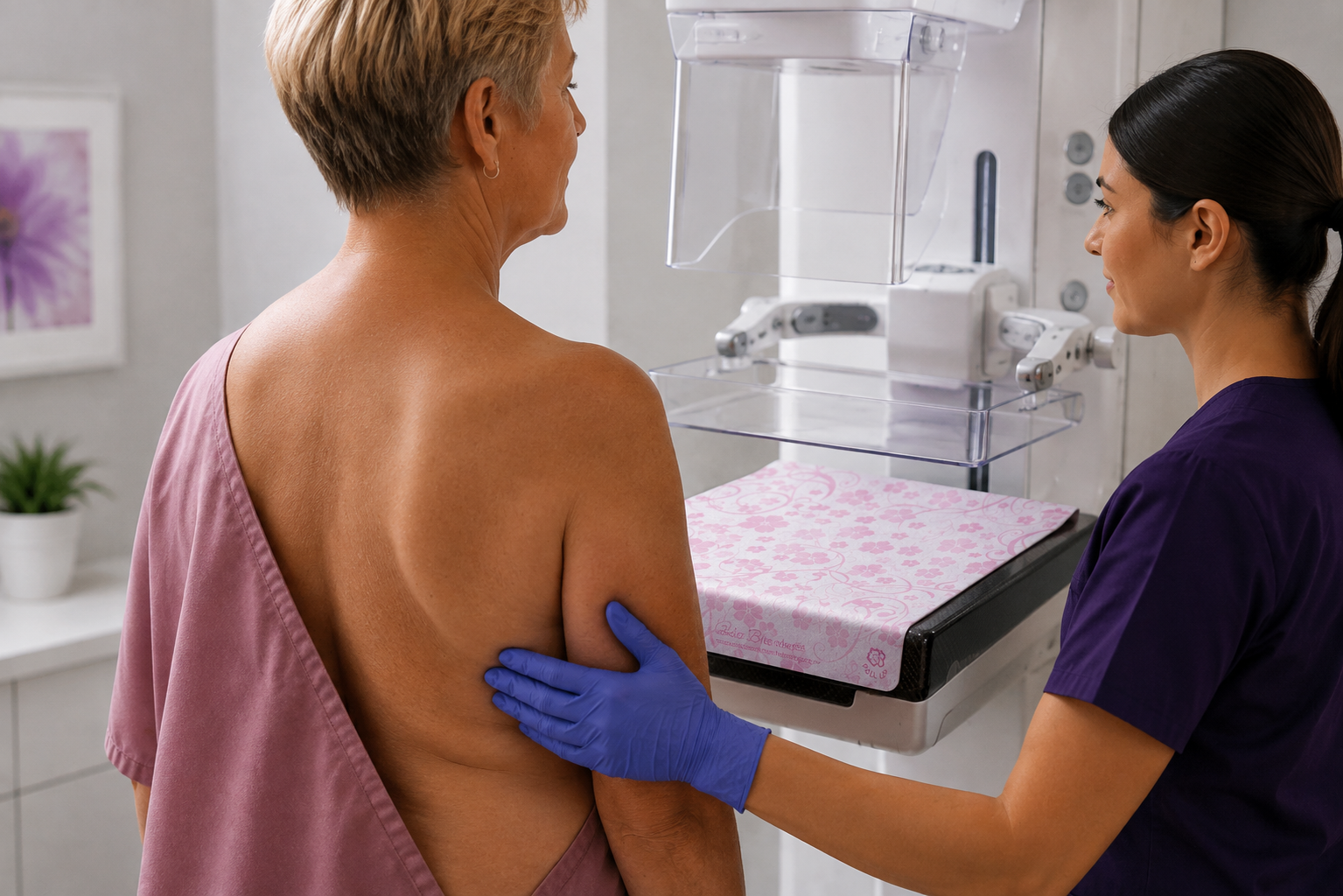
With GLP-1 medications such as semaglutide (Ozempic®, Wegovy®) and tirzepatide (Mounjaro®, Zepbound®) becoming widely used for weight management, more patients may be experiencing significant changes in breast volume and skin laxity. And for mammographers, one unexpected effect may be showing up right at the detector: more loose, redundant skin to manage during positioning. You may have even heard the term “Ozempic breasts” used to describe some of these changes.
But in the mammography suite, this isn't really about a trending term. It's about what happens when a patient steps up to the unit.
You position the tissue, only to have it begin to shift as compression is applied. You smooth a skin fold, and it wants to come right back. Or you're trying to capture the tissue you need while being especially careful with skin that has become thin or fragile.
For these patients, Bella Blankets® protective coverlets can help technologists achieve and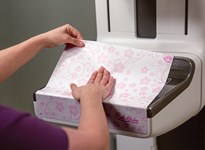 maintain positioning more quickly by reducing tissue shift and the need for repeated adjustments, while also providing a protective barrier for fragile skin.
Why You May Be Seeing More Loose Skin
The breast is composed largely of fat. When a patient loses a significant amount of weight, breast volume can decrease along with fat elsewhere in the body. But the skin doesn't always change at the same rate.
Harley Street Breast Centre noted that older patients or those with less baseline elasticity, the skin envelope that once accommodated a larger breast volume is left with excess tissue that drapes more readily, resulting in looser, more redundant skin and visible sagging.
Research is beginning to document breast changes associated with GLP-1-related weight loss as well. A 2025 case-based review described changes in breast compression thickness and mammographic appearance following GLP-1-associated weight loss. A 2026 narrative review also identified skin laxity as a concern following GLP-1-related weight loss.
For mammographers, the takeaway is practical: a patient who positioned easily at a prior exam may present a very different positioning challenge after significant weight loss.
There may be less volume to work with and more loose skin to manage and maintaining control of that tissue throughout positioning and compression may become more difficult.
When a Skin Fold Becomes More Than a Frustration
Skin folds certainly aren't new to mammography. Experienced technologists have been managing them long before GLP-1 medications entered the conversation. But more redundant skin can make those folds harder to prevent.
Skin and fat folds are recognized causes of technical recalls and may create densities on an image or potentially obscure underlying breast tissue. One study examining mammography positioning standards found skin folds in the inframammary fold area on 35% of FFDM images and 45% of DBT images.
That doesn't mean every fold requires a repeat. Louise Miller, Co-Founder of Mammography Educators, notes that DBT may allow radiologists to scroll through a fold when it isn't obscuring tissue.
 The goal isn't necessarily a perfectly fold-free image on every patient. It's getting the tissue you need while minimizing folds that could interfere with visualization.
And when loose skin keeps shifting, folding or moving during compression, having additional positioning support can make a difference.
More Positioning Support. More Control. Added Protection.
Bella Blankets are placed over the receptor plate to create a textured, non-slip positioning surface. For patients with loose or redundant skin following significant weight loss, that surface can help reduce movement against the detector and help technologists maintain the positioning they've worked to achieve.
Helps keep tissue in position - Loose skin and breast tissue can shift as compression is applied. Bella Blankets provide a non-slip surface that helps reduce that movement, giving technologists more control throughout positioning and compression.
Helps manage wrinkles and folds - Keeping tissue more stable can make it easier to smooth wrinkles and folds and maintain positioning as compression is applied. That additional support can also help with tissue acquisition, including challenging MLO positioning.
Provides a protective barrier for fragile skin - For patients with thin or fragile skin, positioning can require an especially gentle approach. Bella Blankets provide a soft barrier between the patient's skin and the image receptor, helping protect vulnerable skin during the exam.
For the technologist, that additional support can mean less time repositioning tissue that shifts or addressing folds that keep returning.
For the patient, it can mean less manipulation of sensitive or fragile skin while helping the technologist capture the quality images needed.
What Can That Look Like in Practice?
Dr. Amy K. Patel, Medical Director of the Breast Care Center at Liberty Hospital and Associate Professor of Radiology at the University of Missouri-Kansas City School of Medicine, documented the use of Bella Blankets with a patient who had a recurring history of skin folds on previous mammograms.
When Bella Blankets were used during her 2025 exam, Dr. Patel reported that they helped “smooth out the wrinkles” seen on prior mammograms and improved MLO positioning, allowing more pectoralis muscle to be visualized.
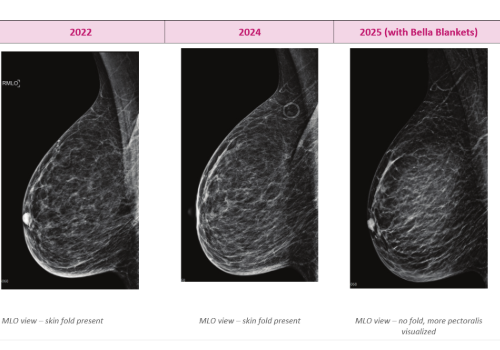
It's a good example of why additional positioning support can matter. The benefit isn't simply a cleaner-looking image. Helping keep tissue in position can support the technologist in maintaining the positioning they've worked to achieve and reducing folds that could interfere with visualization or potentially contribute to a technical recall.
Patients Change. Mammographers Adapt.
Mammographers have always adapted their positioning to the patient in front of them.
Different breast sizes. Different body types. Limited mobility. Surgical changes. Fragile skin. And now, for some patients, significant weight loss that may leave more loose or redundant breast skin to manage.
GLP-1 medications may be a relatively new reason we're talking about these changes, but the challenge itself is familiar: how do you get the tissue you need while taking care of the patient in front of you?
Good positioning skills will always be at the center of that answer.
And when loose, fold-prone or fragile skin makes positioning more challenging, Bella Blankets can be another tool technologists have available to provide additional positioning support and skin protection as they adapt to the needs of each patient
Every patient brings different positioning needs. If you'd like to see how Bella Blankets can provide added positioning support while helping protect fragile skin, we're happy to let you experience them for yourself. Request a complimentary sample of Bella Blankets.