
 MRI technology never stands still. Over the years, scanners have become faster, image quality has improved, and new pulse sequences and AI-assisted tools continue to shape the way MRI departments work.
The same can be said for many of the products that support MRI, including dedicated skin markers like MR-SPOT®, which were developed specifically to help localize areas of pain, palpable masses, and other points of interest.
But while many parts of MRI have evolved, some everyday habits have remained surprisingly unchanged.
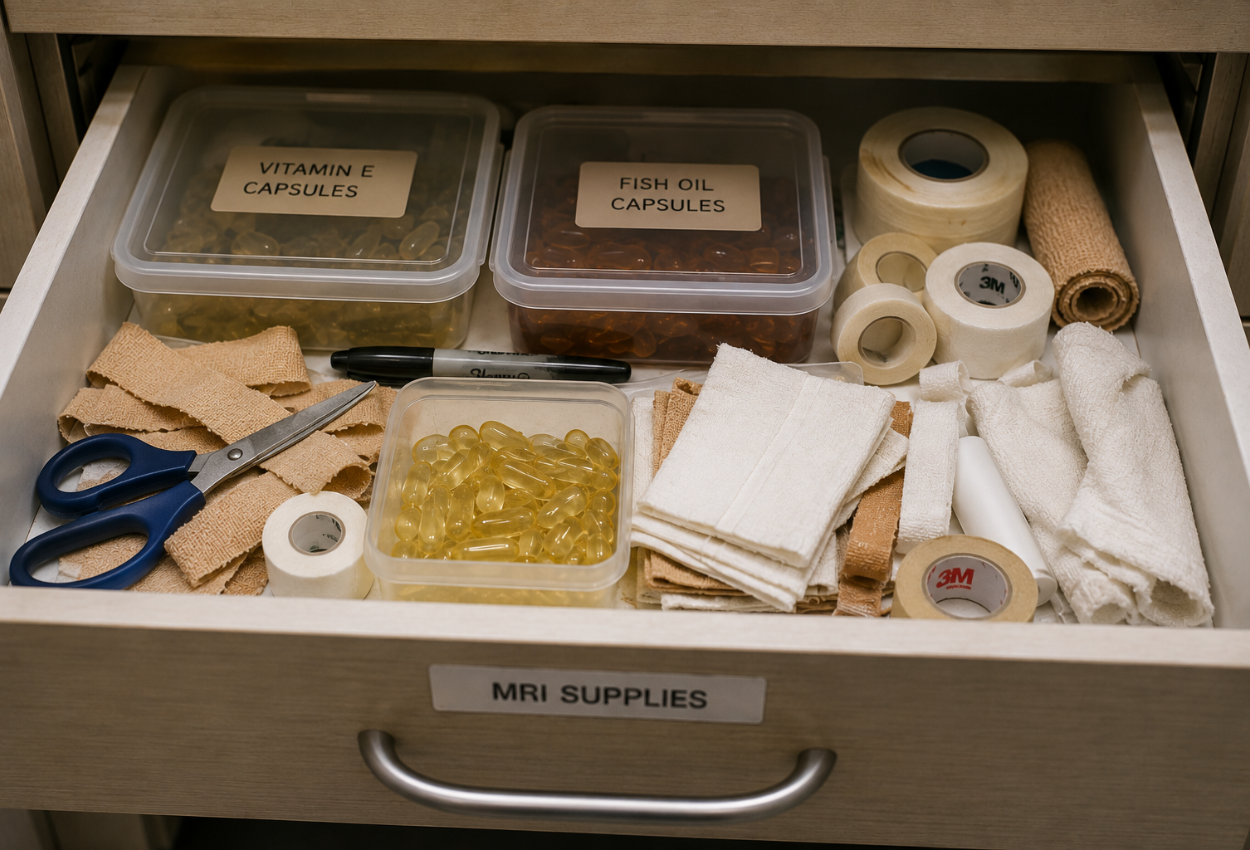
Every MRI department seems to have that drawer, the one filled with tape, vitamin E capsules, fish oil capsules, and little workarounds that have somehow survived every scanner upgrade.
For many technologists, these improvised skin markers have simply become part of the routine. They work well enough, they've always been there, and replacing them rarely makes the top of anyone's priority list.
But it's worth asking: Has every part of the MRI workflow kept pace with the technology around it?
The Resourcefulness of MRI Technologists
MRI technologists have always been problem-solvers.
Long before dedicated MRI skin markers became widely available, departments found creative ways to localize areas of pain, palpable masses, and other areas of concern. Vitamin E capsules, fish oil capsules, and other makeshift solutions became common because they were accessible and got the job done.
Today, dedicated MRI skin markers like MR-SPOT® offer an option that was designed
specifically for MRI. Available in both tube and packet styles with multiple sizes, MR-SPOT provides a bright, consistent image across all pulse sequences, giving technologists the flexibility to choose the right marker for each patient and clinical application.

That doesn't mean the old methods were wrong. They solved a need at the time. But healthcare is constantly evolving, and sometimes it's worth taking another look at the everyday tools we use.
Small Tools Can Have a Big Impact
A skin marker may seem insignificant compared to the MRI scanner itself, but how consistently that marker appears can have a meaningful impact on image interpretation.
One of the biggest advantages of MR-SPOT® Skin Markers is their bright, consistent image across all pulse sequences. When a radiologist identifies pathology on a particular sequence, the marker is there too, making it easier to immediately see its relationship to the area the patient identified.
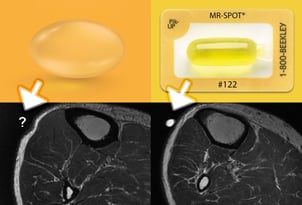 That isn't always the case with makeshift markers. If a vitamin E or cod liver oil capsule isn't visible on the sequence where the finding is best seen, the radiologist may have to return to another sequence where the marker is visible and correlate the location between images. That adds time to the interpretation and can make precise localization more challenging.
MR-SPOT helps eliminate that extra step by providing a consistent point of reference throughout the study.
Another important difference is what happens beneath the marker itself. Vitamin E and cod liver oil capsules typically need to be taped firmly against the skin, which can create indentation and artifact that may affect the appearance of the underlying anatomy.
MR-SPOT Packets™ have a low, flat profile designed to minimize indentation, making them particularly well suited for dedicated coils and weight-bearing studies. MR-SPOT Tubes can also help avoid indentation when they aren't weight-bearing because the marker sits above the skin rather than pressing directly into it.
The result is a marker that does its job without unnecessarily getting in the way of the anatomy the radiologist is trying to evaluate.
For the technologist, these may seem like small details. For the radiologist, they can mean less time spent correlating between sequences and a clearer, more consistent reference to the area the patient identified.
Shouldn't Every Tool Be Designed for the Job?
MRI departments invest in advanced scanners, specialized coils, optimized imaging protocols, and ongoing staff education, all with the goal of producing high-quality, consistent exams.
The same philosophy can apply to the everyday tools used throughout the exam.
Skin markers may be one of the smallest items in the MRI suite, but they're one of the few tools that directly connect what the patient is feeling with what the radiologist sees. Choosing a marker designed specifically for MRI can help support more consistent localization, improve communication, and simplify workflow.
Sometimes improving an exam isn't about making a dramatic change.
Sometimes it's about replacing an improvised solution with one that was designed for the task.
Has Your Workflow Kept Pace?
Every MRI department has routines that started for good reasons. The same is true for that drawer.
Years ago, vitamin E capsules, fish oil capsules, and other makeshift markers earned their place because dedicated MRI skin markers weren't widely available. They filled a need and became part of everyday workflow.
Today, MRI departments have purpose-built options like MR-SPOT® Skin Markers. Designed
specifically for MRI, they provide bright, consistent visualization across all pulse sequences while helping clearly communicate areas of concern between the patient, technologist, and radiologist.
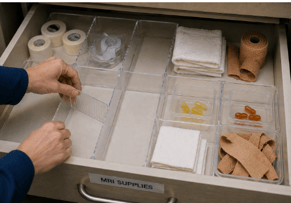 The next time you reach into that familiar drawer, take a second look.
If you were stocking it for the first time today, what would you put in it?
Sometimes keeping pace with technology isn't about replacing the scanner or adopting the latest software. Sometimes it's about replacing the small workarounds we've simply gotten used to.
Explore the full MR-SPOT product line to learn how dedicated MRI skin markers can help support consistent localization and clear communication throughout every MRI exam.