 A child finishes their radiation therapy simulation and heads home. Maybe later that day they're outside playing with friends. Maybe they have soccer practice. Maybe it's summer and they're hoping to get back in the pool. They're trying to enjoy the same activities they did before their cancer diagnosis, even as treatment becomes part of their routine.
But they're also carrying something home from simulation: the marks that will help their radiation therapy team reproduce their setup at the next appointment.
Traditionally, one way to create those marks has been with a needle and ink, leaving behind a permanent tattoo. For a mark that may only be needed during treatment, does it need to last a lifetime?
Another Option for Pediatric Patient Marking
At a recent radiation oncology meeting, a radiation oncologist stopped by our booth and shared that they had used InkRight® Semi-Permanent Tattoos with a pediatric patient and were considering using them with similar patients in the future.
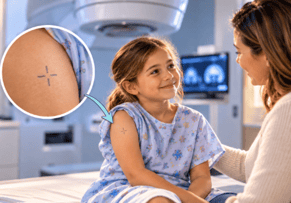 InkRight provides a needle-free, semi-permanent alternative to traditional radiation therapy tattoos. The marks are water-resistant and can be reapplied by the care team as needed, offering a way to maintain setup marks throughout treatment without permanently marking a child's skin.
Those benefits aren't unique to pediatric patients. But think about them through the experience of a child and the parents or caregivers helping them navigate treatment.
One Less Needle Can Matter
By the time a child arrives in radiation oncology, needles may already be a familiar part of their healthcare experience. Blood draws. IVs. Medications. Tests.
A setup tattoo may be a very small procedure by comparison, but it's still another needle.
Using a needle-free marking method doesn't change everything a child has to experience during treatment. It simply removes one procedure that doesn't necessarily require one.
And for the radiation therapist, eliminating the needle also eliminates the associated needle-stick risk.
Treatment Is Only Part of Their Day
Then that child goes home. Radiation therapy has become part of their life, but it isn't their entire life. On the days they feel well enough, they still want to be kids, whether that means playing outside, going to school, or spending time with friends.
A setup marking process needs to account for that reality.
Once the initial application and aftercare period is complete, children can resume their normal activities. InkRight's water-resistant marks offer a practical option for maintaining setup marks throughout treatment. If a mark begins to fade, families should contact their radiation therapy team, who can determine whether reapplication is needed.
The goal isn't to ask a child to organize everyday life around their setup marks. It's to have a marking option that can work with everyday life.
And Then Treatment Ends
The setup mark has done its job. The appointments stop. The child moves on to whatever comes next. But with a traditional tattoo, the mark remains.
For a young child, that could mean carrying a mark created for a relatively short period of treatment for decades to come. Some patients or their parents may never give that tiny tattoo another thought. Others may not want a permanent reminder of their treatment on their skin.
And for parents making medical decisions on behalf of a young child, the ability to avoid a permanent tattoo may be especially meaningful.
As children grow older, they may develop their own feelings about having a visible reminder of a treatment they underwent years earlier.
A semi-permanent mark offers another option: one that can be maintained while it's needed without automatically becoming something the patient carries long after treatment is over.
There are much bigger decisions involved in pediatric radiation therapy than how a patient's skin is marked. But sometimes patient-centered care can also be found in the smaller details.
One less needle. A mark that can keep up with everyday life. And when treatment is over, no permanent tattoo left behind.
For pediatric radiation therapy teams, having another marking option means being able to consider not only the needs of treatment, but also the needs of the children and families in their care. For a child who already has a lot to navigate, that may be a small change worth considering.
Learn more about InkRight® Semi-Permanent Tattoos and how they provide a needle-free, semi-permanent option for radiation therapy patient marking.