 You may never touch the bottle. But once the CT images appear on your screen, the decisions behind your department’s oral contrast protocol become part of your workflow. Breeza® flavored beverage for use with oral iodinated contrast is an oral prep to which iodinated contrast is added.
For the technologist, that can simplify preparation. For the patient, it can make the drinking experience more manageable. And for the radiologist, it can help support a protocol designed around what you need to see.
What Happens Between the First Sip and the Scan?
With iodinated oral contrast, what the patient initially drinks isn’t necessarily what you’ll see throughout the bowel at imaging.
Diagnostic radiologist Dr. Peter Quagliano explains that as diluted iodinated contrast travels through the small bowel, water is progressively absorbed while the contrast remains within the GI tract. As a result, the solution becomes more concentrated and its Hounsfield unit value increases.
That means dilution is only one piece of the equation. The desired contrast HU, degree of bowel lumen filling, extent of bowel filled at imaging, volume consumed, and timing of the scan all need to be considered when developing an oral contrast protocol.
For the radiologist, those decisions ultimately influence the study you sit down to interpret.
 What Are You Actually Trying to Achieve?
It sounds like a simple question, but it’s worth asking. Are you getting the degree of bowel opacification you want? Is the lumen adequately filled? Are you seeing the consistency you expect across studies? And is the protocol timed appropriately for the anatomy you need to evaluate?
There isn’t one protocol that will be ideal for every patient and every clinical situation. Dr. Quagliano makes that clear.
But that doesn’t mean the oral contrast protocol should simply be whatever the department has always used. Your expectations as the interpreting radiologist should help shape it.
Where Do Timing and Taste Come Into the Equation?
In his published protocol for routine adult abdominal and pelvic CT, Dr. Quagliano describes mixing ionic iodinated contrast with Breeza flavored beverage for use with oral iodinated oontrast.
The timing is particularly important.
With the protocol, patients are able to drink the oral contrast mixture over 60 minutes, with scanning beginning between minutes 70 and 75. That gives the contrast time to progress through the GI tract while providing the CT team with a defined timeline that can help keep the exam on track.
But a protocol only works if the patient can complete it.
That can be especially relevant when using iodinated oral contrast products known for a bitter taste. Breeza flavored beverage for use with oral iodinated contrast is formulated with a bitterness blocker designed to completely mask that bitter taste, making the mixture easier for patients to drink and helping enable them to finish within the protocol’s 60-minute drinking window.
Using his suggested mixing and administration protocol, Dr. Quagliano reported relatively uniform enhancement of the stomach and small bowel for most patients, while noting that individual differences can occur and colonic enhancement is variable.
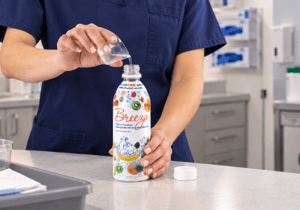
Breeza flavored beverage for use with oral iodinated contrast comes in a ready-to-serve tropical fruit-flavored, intentionally underfilled bottle, allowing the iodinated contrast to be added directly to the bottle.
The result is a protocol that considers more than what happens on the final image. It connects what the patient can realistically drink, how long they have to drink it, when the scan takes place, and what the radiologist ultimately needs to see.
If Your Protocol is Changing, Look at the Whole Picture
When a familiar oral contrast option becomes unavailable, availability may start the conversation. But it doesn’t have to be the only consideration.
Look at the timing. Look at the drinking experience. And look at the resulting images.
If your team is already evaluating alternatives, it may be an opportunity to build an oral contrast protocol that works for the patient, keeps the CT workflow moving, and supports the exam you need to interpret.
If your team is already evaluating alternatives, it may be an opportunity to build an oral contrast protocol that works for the patient, keeps the CT workflow moving, and supports the exam you need to interpret. Request a complimentary sample and bring your CT team into the conversation.