 A patient arrives for a procedure already uneasy. By the time they check in, change into a gown, and wait for someone to come get them, that feeling may have had plenty of time to grow. The nurse caring for them sees it, but that nurse is also balancing everything else that needs to happen to keep the patient’s care moving forward.
It’s a familiar challenge in healthcare: How do you create a better experience for the patient without creating more work for the people caring for them?
That’s one reason simple interventions like Elequil Aromatabs® aromatherapy are worth considering. For the patient, Aromatabs can help calm anxiousness and provide comfort during stressful moments in care. For the nurse, they provide a simple, non-pharmacological option that can be offered without adding a complicated step to the workflow.
The intervention itself is simple. But the growing body of evidence behind clinical aromatherapy suggests its impact can extend beyond that individual moment.
Patient Experience Matters to the Healthcare System, Too
When that patient eventually leaves, their experience doesn’t necessarily stay in the exam room, recovery area, or hospital room.
 It can influence how satisfied they are with their care, what they tell family and friends, what they share online, and whether they would choose the same facility again. Patient experience also contributes to hospital quality assessments, including the CMS Overall Hospital Quality Star Rating.
That makes improving the patient experience both a human consideration and an organizational one. And there is an interesting finding in the Elequil evidence that connects the two.
In a clinical evaluation conducted in a hospital PACU, 72% of patients using Elequil Aromatabs for pain and anxiousness said they felt their comfort was managed very well. That’s a significant response to a relatively simple intervention.
The patient isn’t thinking about satisfaction metrics or organizational goals in that moment. They’re thinking about how they feel and whether the people caring for them recognize it. But those two perspectives aren’t completely separate.
A patient who feels that someone noticed their discomfort and tried to help may leave with a different impression of their care than one who felt their needs went unnoticed.
One Intervention, Many Different Patient Moments
The nervous patient waiting for surgery isn’t the only person who may need a little extra support.
It could be a woman preparing for a breast biopsy, a child anticipating an IV, someone recovering after surgery and feeling queasy, or an MRI patient beginning to wonder whether they can tolerate the rest of their exam.
Elequil Aromatabs have been studied across these and other care environments, and the findings help show what clinical aromatherapy can look like when incorporated into everyday patient care.
In one outpatient surgery study, 75% of patients reported a decrease in anxiety scores after receiving lavender aromatherapy. During a randomized controlled study involving women undergoing image-guided breast biopsy, Lavender-Sandalwood aromatherapy was associated with a statistically significant reduction in self-reported anxiety compared with placebo.
Looking more broadly, approximately 71% of 709 patients across eight clinical studies and quality improvement projects and one patient survey experienced an improvement in anxiety/anxiousness, comfort, or overall patient experience after receiving Elequil Aromatabs.
The settings and patient needs vary, but there is a common thread running through them: healthcare professionals regularly encounter patients who are anxious, uncomfortable, queasy, stressed, or simply in need of a little more support.
Having something simple to offer in that moment can make a difference.
What Helps the Patient Can Sometimes Help the Workflow
There’s another side to patient experience that doesn’t always get as much attention.
When a patient is struggling, the healthcare professional caring for them may need to spend additional time reassuring, coaching, or supporting them. That’s part of patient care, but in a busy department, those additional minutes can affect the workflow around them. MRI provides a good example.
Research summarized in the clinical evidence review found that patients using Elequil Aromatabs experienced reduced anxiousness and claustrophobia, along with a decrease in the number of patients requiring 15 minutes or more of coaching to complete their exams. The findings also pointed to the potential for greater operational efficiency through fewer aborted scans.
It’s an example of how supporting the patient and supporting the healthcare professional don’t necessarily have to be competing priorities.
When a simple intervention helps a patient feel calmer or more comfortable, it may also make that patient’s care easier for the healthcare professional to navigate.
Patients Take Note
Perhaps one of the strongest indications of what these small interactions mean comes directly from patients themselves.
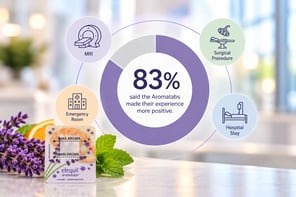
In a survey of people who received Elequil Aromatabs during an MRI exam, surgical procedure, emergency room visit, or hospital stay, 83% said the Aromatabs made their experience more positive.
One Aromatab isn’t responsible for everything that happens during a patient’s visit, and patient experience isn’t something a healthcare organization can improve with a single intervention.
But that may be exactly why these smaller moments deserve attention.
Patient experience is built throughout the course of care, including the moments when someone recognizes that a patient is struggling and has an easy way to offer additional support.
For the healthcare system, that can mean supporting a more positive patient experience while potentially reducing some of the burden associated with managing anxiousness and discomfort. For the nurse, it means having a simple option they can offer when they see a need. And for the patient, it can mean feeling a little calmer, a little more comfortable, and a little more cared for.
Sometimes a small intervention can change more than just the moment.
See what clinical aromatherapy could look like in your facility. Explore Elequil Aromatabs® and the clinical evidence behind their use across a variety of patient care settings.