
 Dear Dosimetrist, First, thank you. Thank you for somehow turning my simulation scans into clinically elegant treatment plans while surviving an inbox full of “quick" questions, last-minute schedule changes, and contour revisions labeled urgent. I know what you’re thinking when a new CT dataset lands in your queue. Please let this one be clean.
And honestly? Same.
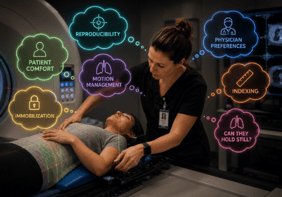 Because despite what people outside radiation oncology may think, simulation therapists aren’t just taking pictures. We’re thinking about reproducibility, indexing, patient comfort, physician preferences, immobilization, motion management, and whether the patient who just said, “I can hold still no problem,” actually means it.
All before 9:00 AM.
Which brings me to skin markers.
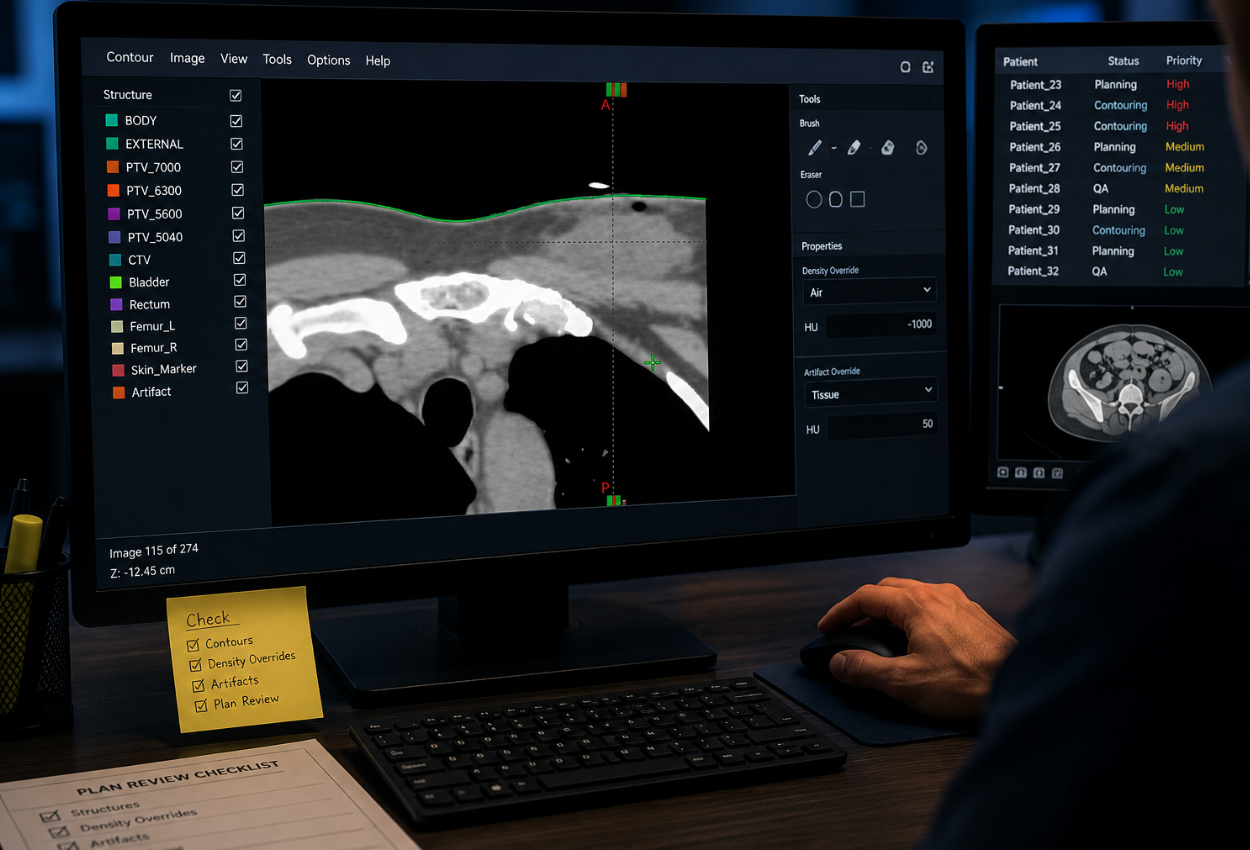
Traditional skin markers used in treatment planning do what they were designed to do: show up. Unfortunately, they sometimes show up a little too well. When markers appear inside the automatic body contour, it’s someone’s job to compensate for the markers and any associated artifact. That means manually contouring the marker, overriding it to air density, and correcting any surrounding artifact to match the adjacent tissue. Usually, that someone is you.
When contouring markers that are flush to the skin, there is a risk of accidentally including skin in the contour, introducing inaccuracies that no one wants to discover later.
Individually, it may feel like it’s only going to take a few minutes. But radiation oncology has a funny way of turning “only a few minutes” into an entire day’s worth of workflow interruptions.
One skin marker clean-up becomes ten.
Ten become part of the normal routine.
Eventually, everyone just accepts the extra step as part of planning.
But maybe not every extra step has to stay.
That’s part of what makes products like RT-SPOT® Elevated Skin Marker interesting to
simulation teams.
RT-SPOT was designed differently from traditional skin markers. Instead of sitting flush against .png?width=274&height=192&name=BeekSpeak%20Blog%20Body%20Image%20(23).png) the skin, it’s a low-density marker on a foam backing that positions the marker just outside the body contour at simulation. The goal isn’t just visibility during simulation, it’s minimizing interference downstream so planners spend less time manually correcting contours and more time delivering high-confidence plans on schedule.
the skin, it’s a low-density marker on a foam backing that positions the marker just outside the body contour at simulation. The goal isn’t just visibility during simulation, it’s minimizing interference downstream so planners spend less time manually correcting contours and more time delivering high-confidence plans on schedule.
In other words: fewer surprise appearances in your workflow.
And honestly, that matters more than people think.
Because one of the most underrated parts of radiation oncology is how connected everyone’s work really is. A small decision made during simulation can quietly affect dosimetry, physics, QA, and treatment delivery hours or days later.
Because that’s what experienced simulation teams do.
So no, we can’t promise every scan will arrive perfectly contour-ready forever. There will still be difficult anatomy days, motion days, and “why is the immobilization device suddenly doing that?” days.
But if there’s a way to reduce unnecessary cleanup before the scan ever reaches your workstation?
We’re interested too.
Sincerely,
The Simulation Therapist Thinking Three Steps Ahead
P.S If you are interested in learning more about RT-SPOT you can request a sample to see if they can help our facility.