
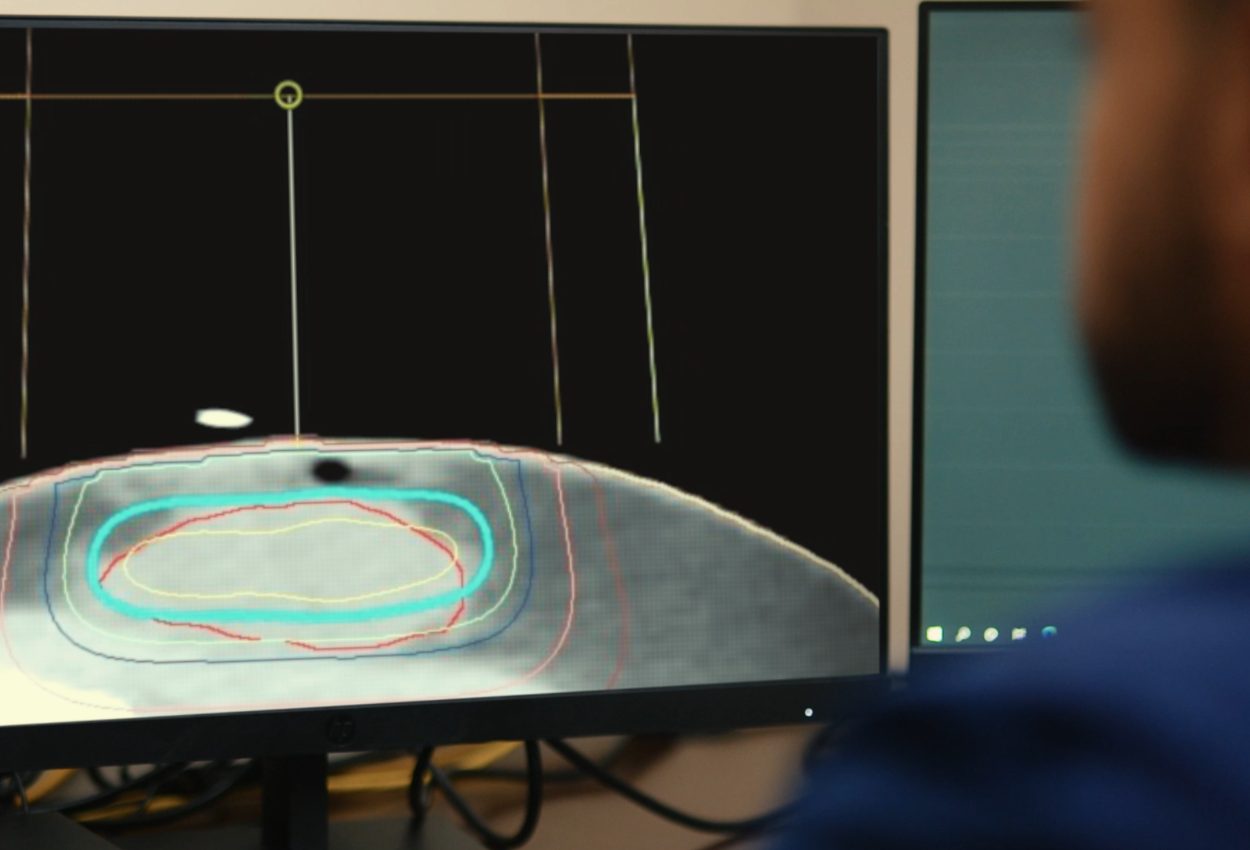
 In radiation oncology, medical physicists work hard to protect dose calculation accuracy. Commissioning, algorithm validation, imaging QA, and machine performance are all tightly controlled.But accuracy doesn’t begin in the planning system. It begins at CT simulation.
One small but repeatable input that can affect planning consistency is the type of skin marker used during simulation, particularly when that marker becomes incorporated into the automatic body contour.
A Small Input That Affects the Planning Process
When a skin marker is captured in the CT and included in the automatic body contour, it becomes part of the dose calculation geometry unless it is manually removed.
That often leads to:
- Increased planning time
- Manual contouring to exclude the marker
- Occasional dose inaccuracies or plan rework if not fully corrected
- Planner-dependent variability in cleanup
Each instance may only take a few minutes to resolve, but across high patient volumes, repeated manual corrections introduce unnecessary variability into what should be a standardized workflow.
For physicists focused on controlling variables, this is an upstream factor worth evaluating.
Controlling Variability at the Source
Once the skin marker is included in the body contour, the planning team must intervene to prevent dose calculation errors.
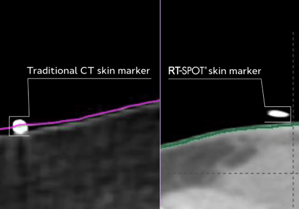
That additional step:
- Requires manual intervention
- Creates opportunities for inconsistency
- Introduces a preventable input into the dose calculation process
Radiation therapy precision depends on reducing avoidable geometric uncertainties wherever possible. Addressing preventable artifacts at simulation is often more efficient than correcting them downstream.
A More Standardized Approach to External Marking
RT-SPOT® Elevated Skin Markers is a skin marker designed to sit above the skin line. Because of its elevation, it helps exclude the marker from the automatic body contour during CT simulation.
By elevating the marker above the automatic body contour and reducing the need for manual contouring, it supports:
- Improved plan accuracy
- Fewer planner-dependent cleanup steps
- Improved planner efficiency
- Greater confidence in dose calculation inputs
It’s not a change in planning technique; it’s a refinement of the simulation input to reduce variability before the plan is even created.
A Physicist-Led Opportunity for Improvement
 Medical physicists are uniquely positioned to evaluate whether routine simulation tools are introducing unnecessary downstream steps.
If your department regularly contours out skin markers during planning, it may be worth asking:
- How often is this manual correction required?
- Is it handled consistently across planners?
- Could a different marker design eliminate the need altogether?
Standardization isn’t only about software and machine tolerance. It also means strengthening the consistency of the inputs that feed the planning system.
To learn more about RT-SPOT® or request a complimentary sample for evaluation in your department, contact info@beekley.com.
Because improving dose calculation accuracy can start with a simple change at CT simulation.