
 Automation has reshaped the body contouring in radiation oncology. Auto-segmentation, atlas libraries, and deep learning tools complete in minutes what once demanded hours of focused attention. The progress is remarkable, but speed introduces a quiet challenge. Machines do not truly see. They recognize shapes, edges, and contrasts, and sometimes those patterns do not tell the whole story.
When Data Needs Help Telling the Right Story
A CT scan contains countless details. Some are vital to patient anatomy. Others exist only to guide the simulation process. A small density on the surface might be a tattoo, a fiducial, or a skin marker used for alignment.
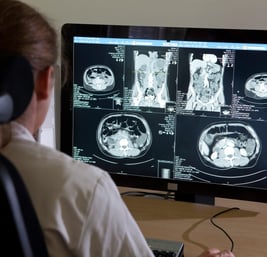 The algorithm doesn't know the purpose behind the skin marker. When skin markers are used, the software may interpret them as part of the patient.
This small misinterpretation can influence the body outline, shift Hounsfield units, or affect margins during planning. A simple object, never meant to shape a dose plan, ends up altering the foundation on which the plan is built.
The human eye interprets meaning, while an algorithm interprets data. A dosimetrist can view a slice and immediately understand the difference between anatomy and something placed on the surface of the skin. Software doesn't share that intuitive sense of purpose. Without clear cues that separate a marker from the patient, the system is left to guess. When that guess is wrong, the intention behind the scan becomes harder to recognize.
Every object inside a CT image sends a message to the system, and accessory design influences how that message is read. RT-SPOT® elevated skin markers were created with that responsibility in mind.
RT-SPOT® Line, Crosshair, and DOTs sit above the skin line so that the marker remains visible to the radiation therapist, but stays outside the automated body contour. This simple geometric choice helps the scan communicate clearly, highlighting what belongs to the patient and what does not.
A Future Built on Shared Understanding
The future of automation in radiation oncology will not remove human insight. Instead, it will rely on tools and systems designed to understand and support that insight.
When the entire imaging chain, from the scanner to the smallest marker, is created with intention and clarity, automation does not overshadow human meaning. It strengthens it.
To learn more about RT-SPOT® elevated skin markers for CT simulation, contact your Radiation Oncology Account Manager at 1.800.233.5539 or email info@beekley.com.